
To this day, the medical industry continues to receive widespread attention, encompassing upstream sectors like electronics manufacturing, machinery manufacturing, biochemistry, and materials, as well as downstream sectors such as healthcare - all closely related to our daily lives. In the medical industry, safety and traceability are essential components. For the inspection, screening, and information tracing of various medical products, machine vision inspection equipment and barcode reading solutions can be utilized. These not only ensure the safety and traceability of medical products but also significantly reduce labor costs, advancing medical products into intelligent and digital management models.
Testing Screening and Information Traceability Across the Medical Industry Supply Chain
Project Background:
China Drug Electronic Supervision Code Management System is designed to monitor the status of drugs during production and circulation, enabling regulatory authorities and manufacturers to trace and manage products while protecting the legitimate rights and interests of pharmaceutical producers and consumers.
By assigning identification codes, the system interconnects product data. As drugs move along the production line, barcode readers automatically scan the codes according to cycle time and upload the information to the system for traceability and management.
Barcode Reading Challenges
1.Reflective and wrinkled barcodes on blood bags
2.Curved surfaces of bottles causing difficult barcode reading
3.Changing packaging box dimensions/styles leading to variable barcode positions
Solution:
1.For barcodes that are curved or distorted due to uneven packaging surfaces, AI-powered intelligent decoding algorithms can be employed to ensure effective reading of warped and deformed barcodes.
2.The reflection caused by ambient light on blood bags can be resolved by installing polarizing filters on the barcode reader, which effectively suppresses surface glare from non-metallic materials.
3.Variations in packaging box dimensions and styles that cause barcode position changes can be addressed by adjusting the quantity and mounting configurations of barcode readers based on actual production requirements, ensuring multi-surface readability.
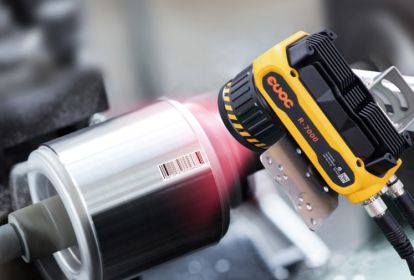
In such production environments, the R-2000 Series and R-3000 Series barcode readers are widely adopted.
The R-2000 Series barcode reader delivers the highest cost-performance ratio for pharmaceutical production with uniform packaging dimensions and fixed installation positions. As a fixed-focus reader, it provides clear imaging at preset working distances and fields of view, while supporting polarizer attachments to eliminate surface reflections.
The R-3000 Series barcode reader is one of the optimal choices for pharmaceutical production scenarios with minor packaging dimension variations. Compared to the R-2000 Series, the R-3000 Series supports manual focus adjustment and delivers superior high-speed reading performance, making it applicable to more scenarios.

 4000-697-797
 518057
 jmsales@qevoc.cn
 EVOC Technology Building No. 31 Gaoxin Middle Fourth Road Nanshan District Shenzhen
二维码


 粤公网安备 44030502007980号