
The current home furnishings market has gradually shifted from a seller's market to a buyer's market, with accelerated industry customization development and the establishment of a full-process service system becoming a long-term strategic direction. With this market shift, the integration of online and offline channels in the home furnishings industry is accelerating, and consumer demands for logistics services are increasing, transitioning from extensive management to refined management. As emerging technologies such as big data, cloud computing, and artificial intelligence continue to penetrate home furnishings companies, the share of China's internet-based home improvement in the overall residential decoration market has risen from 12% in 2016 to 20% in 2020. In terms of consumer purchasing channel preferences, purely offline buyers account for only 30%, while the combination of online and offline selection has become the mainstream trend, making the integration of online and offline channels in the home furnishings industry increasingly prominent. With the accelerated integration of online and offline channels, the home furnishings industry's digital transformation and logistics service requirements have reached a new level. The previous extensive management can no longer meet the new demands of the digital transformation process, and the home furnishings industry supply chain is moving toward refined management
Refined Management of Logistics in the Home Furnishings Industry Chain to Achieve Information Recording and Quality Traceability Requirements
Project Background:
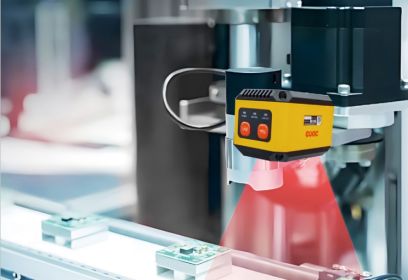
The barcode reader is installed above the conveyor belt in front of the edge banding machine. The conveyor transports the pre-marked raw material boards to the "recognition" position, where the reader scans the QR code on each board. It then transmits the encoded information—including customer name, component name, cutting dimensions, and product name—to the edge banding equipment. This enables the recording of each board's processing data into the traceability system, completing full-process tracking of the entire manufacturing chain.
Barcode Reading Challenges
1.Multiple barcode types (various-sized 1D/2D codes)
2.Variable labeling positions requiring large scanning areas
3.Dust accumulation on tile surfaces affecting QR code readability
4.Prone to stains/damage (abrasion during production)
Solution Advantages:
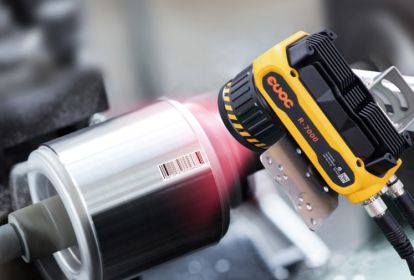
1.The R-6000 series barcode reader integrates the industry-leading AI decoding algorithm, featuring enhanced decoding capability and faster processing speed. It can efficiently read various types of barcodes and QR codes simultaneously, unaffected by dirt, damage or other interferences.
2.With a significantly expanded field of view - nearly twice that of the previous generation - it adapts to more application scenarios. A single unit can easily handle multiple barcode reading tasks.
3.Its high-precision mil-grade hardware and software effortlessly read ultra-small codes, delivering exceptional 1D/2D barcode recognition performance with ultra-fast, omnidirectional barcode capture and reading.
Solution Performance:
1.The R-6000 Series Barcode Reader features an expanded field of view and adapts to environments with high barcode density, enabling wide-area scanning of multiple product barcodes.
2.Equipped with high-precision AI algorithms, it accurately decodes all types of 1D/2D codes, unaffected by stains, damage, or other interferences. It’s not just an intelligent scanner—it’s a powerful business tool.

 4000-697-797
 518057
 jmsales@qevoc.cn
 EVOC Technology Building No. 31 Gaoxin Middle Fourth Road Nanshan District Shenzhen
二维码



 粤公网安备 44030502007980号