
Bottle packaging remains enduringly popular in the beverage industry due to its excellent transparency and strong recyclability. Primary bottle packaging materials include glass bottles, plastic bottles, and composite material bottles. Glass bottle packaging: A traditional packaging material in the food and beverage industry, used for various liquid products including alcoholic beverages, juices, condiments, and salad dressings. Plastic bottle packaging: Widely adopted for bottled water, carbonated drinks, juices, and other beverages, representing the most extensively used packaging material in the sector. Composite bottle packaging: Combines the advantages of plastics with other materials, typically employed for premium beverages, coffee products, and high-end drinks.
Achieve barcode scanning requirements across all stages of bottled product production including raw material preparation syrup manufacturing mixing filling quality inspection packaging storage and transportation
Process Flow:
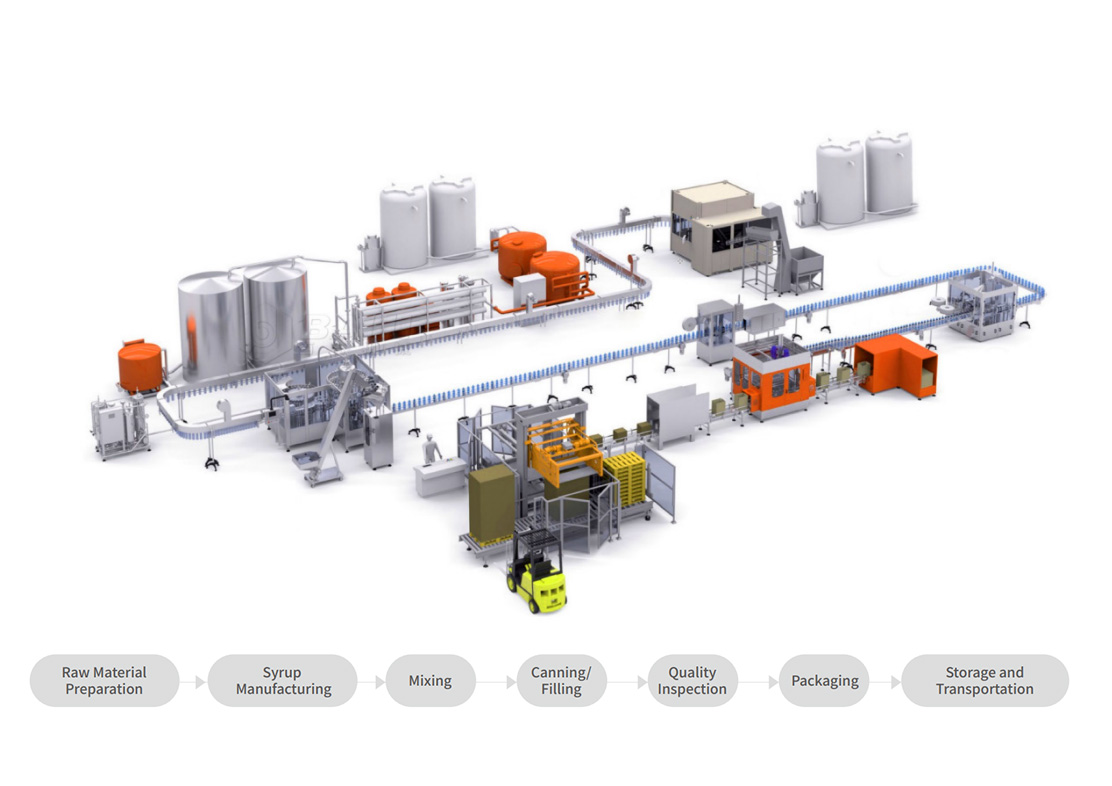
Product Analysis:
Bottle product packaging typically places barcodes/QR codes on curved surfaces, with inherent light transmission characteristics due to material properties.
Industry Requirements:
Diverse bottle shapes and sizes: Varied bottle geometries require barcode/QR code placement on curved surfaces.
Surface reflection: Both glass and plastic materials are prone to ambient light reflection, causing scanning difficulties.
High-speed production lines: Automated lines with rapid throughput demand readers' high-speed decoding capability.
Non-fixed code orientation: Requires multi-directional reading capacity for variably positioned 1D/2D codes.
Contamination and damage: Surface stains, scratches or defects may interfere with scanning accuracy.
Solutions:
1. Barcode Surface Glare Reduction: For reflective surfaces, the scanner supports polarized lens installation. The polarizing filter effectively suppresses glare from non-metallic materials, optimizing overall imaging to enhance scanning accuracy.
2.Curved Surface Adaptation: For distorted barcodes on curved surfaces, our intelligent AI decoding algorithm enables high-speed, stable, and reliable recognition of challenging codes.
Barcode Reader Recommendation:
For applications with consistent bottle dimensions, the fixed-focus R-2000 series barcode reader is recommended. It supports polarizer installation and network connectivity, delivering fast, stable, and cost-effective scanning performance.
For frequently changing bottle sizes, the R-3000 series with manual focus adjustment is advised. Its tunable optics maintain sufficient field-of-view and working distance margins to accommodate dimensional variations.

 4000-697-797
 518057
 jmsales@qevoc.cn
 EVOC Technology Building No. 31 Gaoxin Middle Fourth Road Nanshan District Shenzhen
二维码


 粤公网安备 44030502007980号