
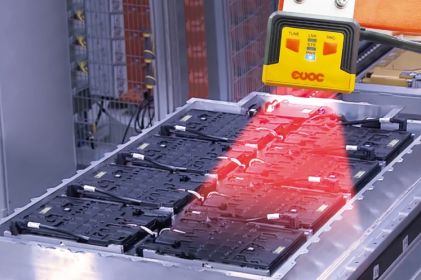
At the screen module assembly station, it is necessary to use a code reader to identify and extract the product ID QR code information to achieve production management across the entire supply chain. Since LCD panels typically use laser engraving for coding and the QR codes are relatively small, ordinary code readers struggle to read them accurately during high-speed movement, often resulting in missed reads. When a code reader fails to capture the code, operators must manually input the barcode, leading to persistent delays in production output. Therefore, enterprises adopt the RegemMarr R-6000 code reader, which not only effectively prevents missed reads but also helps reduce labor costs.
Meet the requirement for accurately reading small barcodes and high-speed moving barcodes
Project Background:
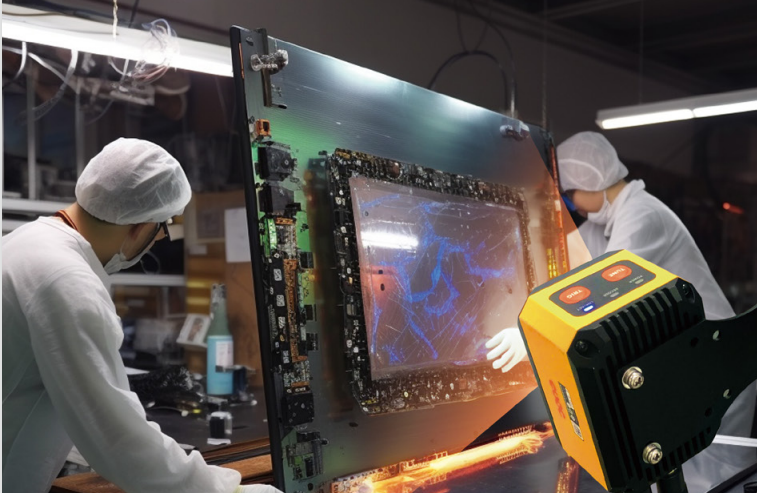
Barcode Reading Challenges:
1. DPM code reading on glass and metal surfaces is prone to reflection, making decoding challenging;
2. Barcodes may suffer from contamination, defects, distortion, tilt, or deformation, with additional interference from production line vibrations;
3. Must support a maximum production line speed of 600mm/s.
Solution Advantages:
1.The R-6000 series code reader is equipped with a high-performance processor and utilizes deep learning AI algorithms, enabling reliable reading even when barcodes are damaged, blurred, low-contrast, or poorly printed.
2.It integrates multiple controllable light sources, including polarized lighting options to eliminate glare interference based on application requirements.
3.The R-6000 series features a high-speed image sensor with rapid response capability, supporting dynamic decoding at speeds up to 1m/s.
Solution Performance:
By utilizing the RegemMarr R-6000 series code reader to capture product code information at the screen module assembly station, the decoding success rate exceeds 99%, effectively eliminating missed scans.
It reduces the need for manual barcode entry by operators, decreasing workload and preventing data input errors associated with manual processes.

 4000-697-797
 518057
 jmsales@qevoc.cn
 EVOC Technology Building No. 31 Gaoxin Middle Fourth Road Nanshan District Shenzhen
二维码


 粤公网安备 44030502007980号