
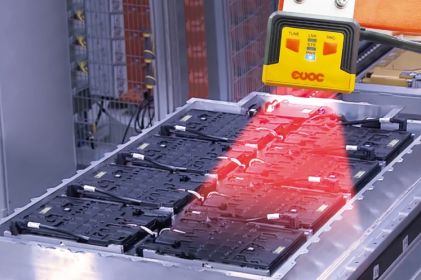
In the lithium battery industry, barcode reading typically refers to scanning QR codes or barcodes on battery cells. This process retrieves critical information including battery identification, production dates, and batch numbers, enabling product traceability and quality control. Industrial-grade barcode readers are employed to meet complex environmental demands and high-precision requirements. Common scanning methods include laser scanning and image recognition. Laser scanners achieve fast, accurate code reading, while vision-based readers utilize image analysis for higher precision decoding. With the rapid advancement of lithium battery technology, barcode reading has become widely adopted. On production lines, readers verify unique battery identifiers, ensuring traceability for quality assurance. The technology also enables full supply chain tracking—from raw materials to end consumers—enhancing product reliability through comprehensive data recording. As a critical industrial application, barcode reading technology: Ensures product traceability (ISO 9001 compliance) Enhances quality monitoring (IEC 62133 standards) Boosts production efficiency (30% faster than manual checks) Improves product quality (<0.01% misidentification rate)
In the lithium battery industry barcode reading typically refers to scanning QR codes or barcodes on battery cells. This process retrieves critical information including battery identification production dates and batch numbers enabling product traceability and quality control. Industrial-grade barcode readers are employed to meet complex environmental demands and high-precision requirements. Common scanning methods include laser scanning and image recognition. Laser scanners achieve fast accurate code reading while vision-d readers utilize image analysis for higher precision decoding.
With the rapid advancement of lithium battery technology barcode reading has become widely adopted. On production lines readers verify unique battery identifiers ensuring traceability for quality assurance. The technology also enables full supply chain tracking—from raw materials to end consumers—enhancing product reliability through comprehensive data recording.
As a critical industrial application barcode reading technology:
Ensures product traceability (ISO 9001 compliance)
Enhances quality monitoring (IEC 62133 standards)
Boosts production efficiency (30% faster than manual checks)
Improves product quality (
Industry Background:
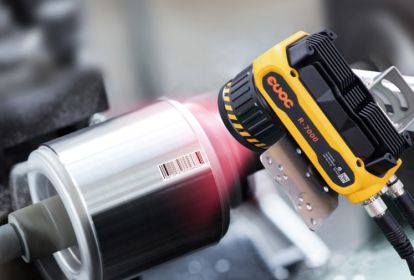
As a type of QR code directly marked on products, DPM (Direct Part Marking) codes offer high counterfeit resistance and durability. They are widely used in industrial manufacturing, logistics management, and anti-counterfeiting traceability applications.
Barcode Reading Challenges:
1.DPM codes have minimal contrast with the background surface, presenting low visual differentiation;
2.The marking depth of DPM codes varies across different products, all requiring compatibility;
3.DPM codes are highly susceptible to interference from stains, scratches and similar defects, significantly impacting readability.
Solution Advantages
1.The R-6000 series code reader is equipped with self-developed AI decoding algorithm and adaptive algorithm adjustment, capable of easily handling various barcodes. It has passed tests on 9 common barcode types including QR, DM, Code 93, and Code 128.
2.Through the combination of camera and algorithm, it has passed tests for different laser marking types including light, medium, and clear barcodes.
3.With over a hundred combinations of camera images and algorithms, it possesses strong anti-interference capability against stains and scratches.
Solution Performance:
1.The demonstration line's five production lines can automatically complete tuning for three different types of DPM codes with one-click operation.
2.During both depth-variation sample testing and 15-day stability testing, there were zero instances of missed code readings.
3.In contamination and scratch sample testing, there were neither missed readings nor misreads. The system has successfully scanned over 1 million codes with zero missed readings.

 4000-697-797
 518057
 jmsales@qevoc.cn
 EVOC Technology Building No. 31 Gaoxin Middle Fourth Road Nanshan District Shenzhen
QR CODE


 粤公网安备 44030502007980号